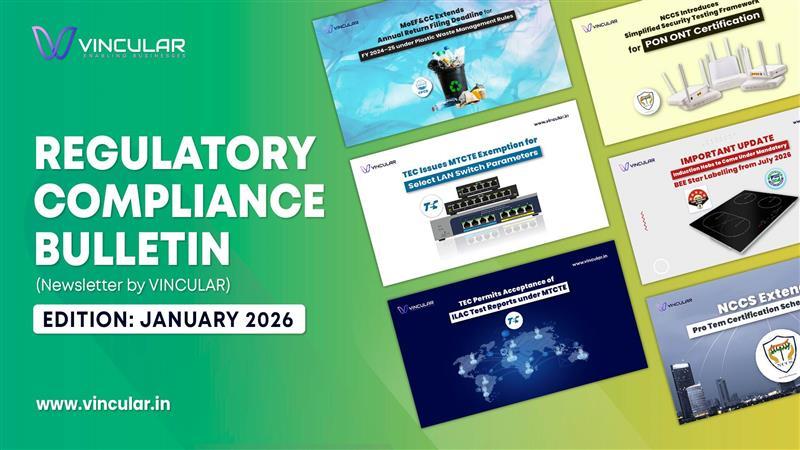
REGULATORY COMPLIANCE BULLETIN NEWSLETTER – JANUARY 2026
NCCS NCCS Releases ITSAR for Layer 2 & Layer 3 LAN Switches The National Centre for Communication Security (NCCS) has officially issued the ITSAR (Indian Telecom Security Assurance Requirements) for Layer 2 and Layer 3 LAN Switches. This marks an important step toward strengthening telecom and network security compliance in India. The
NCCS
NCCS Releases ITSAR for Layer 2 & Layer 3 LAN Switches
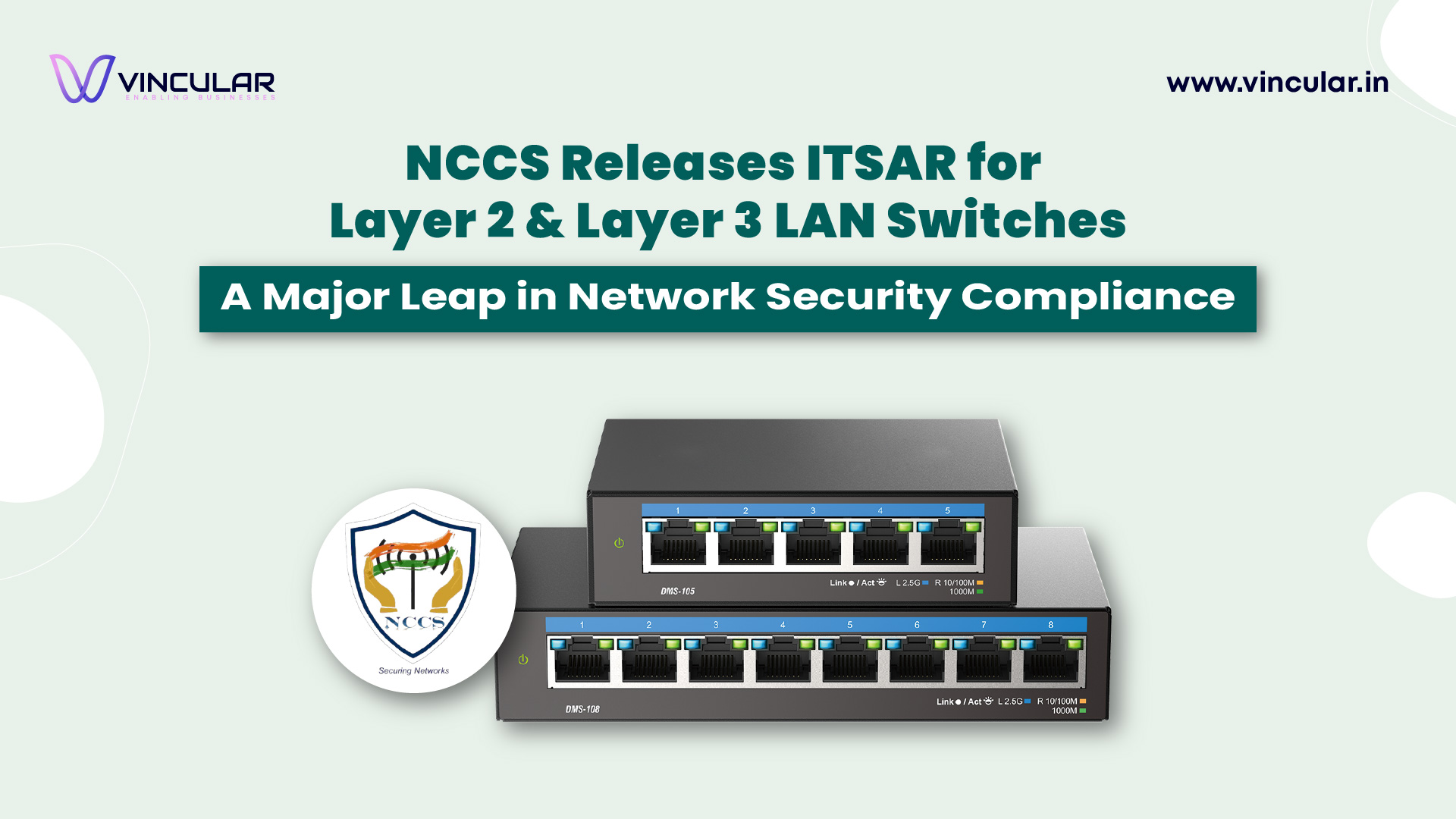
The National Centre for Communication Security (NCCS) has officially issued the ITSAR (Indian Telecom Security Assurance Requirements) for Layer 2 and Layer 3 LAN Switches.
- This marks an important step toward strengthening telecom and network security compliance in India.
- The mandatory date of implementation is expected to be released soon.
Organisations and manufacturers can start reviewing the requirements and preparing in advance while waiting for further notification from NCCS on the implementation timeline.
The new ITSAR document link is available below: L2 and L3 LAN switch ITSAR Circular
We will share updates as soon as the mandatory compliance date is announced.
NCCS Extends Pro Tem Certification Scheme Validity
The National Centre for Communication Security (NCCS) has recently issued a new notification regarding the Pro Tem certificate. As per approvals from the competent authority, the validity of newly issued Pro Tem Certificates has now been extended from 6 months to 2 years.
Key Highlights:
- Effective 5th December 2025, all newly issued Pro Tem Certificates will carry a 2-year validity.
- For existing Pro Tem Certificates approaching expiry, applicants who apply for renewal through the MTCTE portal will receive a renewed certificate valid for the remaining period up to 2 years from the date of their first issuance.
- All other terms and conditions remain unchanged as per the referenced notifications (Ref: NCCS/HQ/ COMSEC/2023-24/III dated 02.10.2024, NCCS/HQ/COMSEC/2023-24/III dated 30.10.2024).
- This new 2-year validity policy will be reviewed after one year.
This extension aims to streamline processes and provide greater ease and flexibility to stakeholders.
You can access the official circular issued by the ministry from here: Pro Tem Certification Scheme Circular
NCCS Clarifies Applicability of ITSAR Provisions to ONU under PON Family of Broadband Equipment
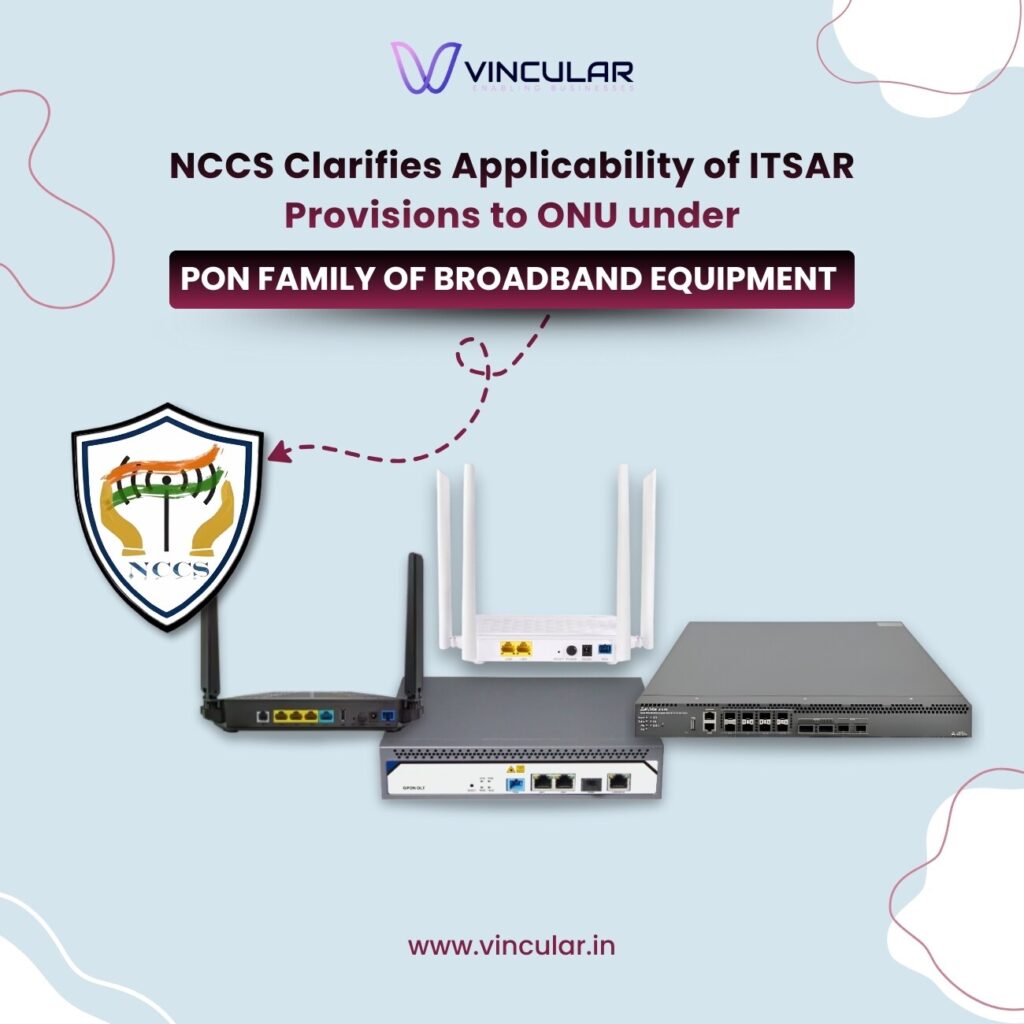
The National Centre for Communication Security (NCCS) has issued a new notification regarding the ‘ONU’ variant listed under the ER ‘PON Family of Broadband Equipment.’
As outlined in the Scope section of the ITSAR ‘NCCS/ITSAR/Customer Premises Equipment/PON CPEs/Optical Network Terminal (ONT) – PON Family Broadband Equipment-V1.0.1’ (released on 24.11.2023), the ITSAR applies to both ONT and ONU devices.
Accordingly, all instructions, circulars, OMs, and notifications issued by NCCS for ONT are also applicable to ONU, effective from the date of issuance of these orders.
You can access the official circular issued by the ministry from here: Applicability of ITSAR Provisions to ONU Circular
NCCS Introduces Simplified Security Testing Framework for PON ONT Certification
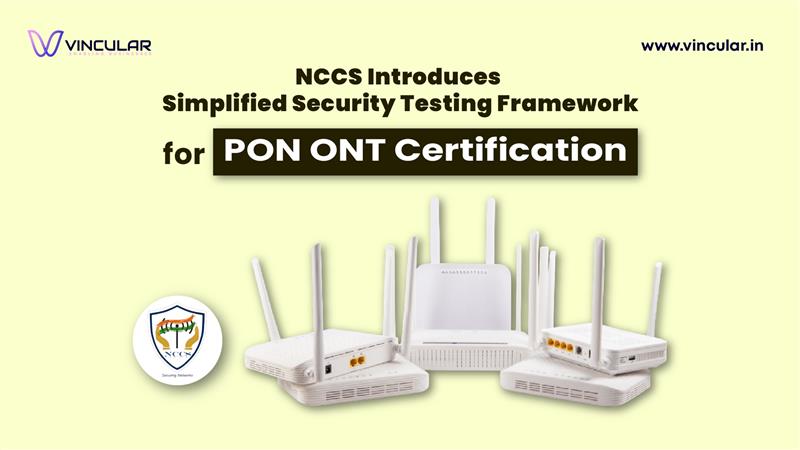
The National Centre for Communication Security (NCCS) has issued a notification on PON ONT certification after considering industry inputs. The testing and certification process for ONT devices and their customised variants has been streamlined to reduce duplication while maintaining strong security assurance.
Key highlights:
- Mandatory Security Testing: Security testing is required only for unique SoC–SDK combinations; additional variants using the same combination are automatically covered without separate testing.
- Self Declaration of Conformity (SDoC): A Self Declaration of Conformity (SDoC) detailing all variant customisations and their software hash values must be submitted during the application process as per the defined format.
- Adding New Variants: To add new customised variants with the same SoC–SDK combination to an existing certificate, OEMs must apply for certificate modification via the MTCTE portal and submit an updated SDoC (Annexure-I) covering both existing and new variants. The modification will be approved without any additional testing.
- SoC or SDK Updates: Any update to the SoC or SDK will be treated as a software update, in line with Section 7 of the Security Certification Procedure.
This approach simplifies compliance, speeds up approvals, and reduces testing overhead—while preserving security standards.
You can access the official circular issued by the ministry from here: Security Testing Framework for PON ONT Circular
WPC
WPC Releases the Much-Awaited NFAP-2025
The Wireless Planning and Coordination (WPC) Wing has released the most-awaited National Frequency Allocation Plan 2025—Map of India’s connectivity landscape. Here’s what every compliance and telecom professional needs to know:
Key highlights:
5G Expansion & New IMT Bands: NFAP-2025 identifies new frequency bands (6425 – 7025 MHz, 7025 – 7125 MHz) for IMT-2020 (5G) services, providing additional spectrum capacity and enabling enhanced capabilities across enterprise, industrial IoT, and consumer verticals.
Satellite Services Boom
The plan actively encourages domestic manufacturing and deployment of:
- High Throughput Satellites (HTS) Allocation of Ka (26.5 GHz to 40 GHz), Q (30 GHz and 50 GHz), and V (40 to 75 GHz) bands.
- High Altitude Platform Stations (HAPS) for remote area connectivity.
- Feeder link optimisation for satellite broadband.
IoT & Emerging Tech Integration
Spectrum allocations for Short-Range Devices (SRDs), Ultra-Wideband (UWB), and M2M communications—critical for medical implants, ground-probing radars, and smart IoT ecosystems.
Harmonization & Coordination
Enhanced V2X technology alignment for trunking services and Public Protection & Disaster Relief (PPDR) spectrum requirements—ensuring interoperability and emergency response readiness, and for satellite-based services.
NFAP-2025 positions India at the forefront of next-gen connectivity while maintaining rigorous spectrum governance. For those of us in regulatory compliance and product certification, this is an opportunity to expand expertise into emerging technologies.
You can access the official circular issued by the ministry from here: NFAP-2025 Circular
TEC
TEC Grants Temporary Exemption from Test Report Submission for Select MTCTE Parameters
The Telecom Engineering Centre (TEC) has issued a new notification on 29th December 2025, granting exemptions from the submission of test reports for specific test parameters related to the following ERs.
- Validity: These exemptions are applicable until June 30, 2026
| S.No. | Product/ER Variant | Parameter Name (as
per ER) |
Standard
Name (as per ER) |
| 01 | Mobile Radio Trunking system | Frequency Band for MRTS | NFAP, Annexe-C1 |
| Conformance to standards for MRTS | ETSI EN 300xxx, i.e. 300-086/219/113/390/296/341
ETSI EN 301 xxx, i.e. 301-166 ETSI EN 302 xxx. i.e. 302-561 Annex-C3 |
||
| Max RF Power Output for MRTS Base Stn. | As per DoT/WPC license conditions, Annex C2 | ||
| 02 | Repeater for Cellular Network | GSM Repeater station operating frequency | NFAP. Annex-F |
| GSM Repeater station parameters | 3GPP TS 51.026 and TS 45.005. Annex F6 | ||
| WCDMA Repeater Station Operating Frequency | NFAP. Annex-F | ||
| LTE Repeater Station Operating Frequency | NFAP Annex-f | ||
| LTE Repeater Station Parameters | 3GPP TS 36.143. Annex- F8 | ||
| 03 | Precision Timing Protocol Grand Equipment | Max Peak Voltage for 10 MHz Interface | G.703 Annex-1 |
| Min peak Voltage for 10 MHz Interface | G.703 Annex-1 | ||
| Profile for frequency synchronisation | Annex-P11 | ||
| Profile for time and phase synchronisation with full timing support | Annex-P11 | ||
| Profile for time and phase synchronisation with partial timing support | Annex-P11 | ||
| Pulse shape for 10MHz interface | G.703 Annex-1 | ||
| Pulse shape for 1 MHz interface | G.703 Annex-1 | ||
| Rise time for 1 PPS interface | G.703 Annex-1 | ||
| 04 | VHF UHF Radio System Equipment | Conformance to standards for VHF or UHF Radio systems | ETSI EN 300xxx i.e 300-113/086/219/390/296/341/698/783/720
ETSI EN 301-xxx i.e 301-783/925/178 Annex-c3 |
| Max Transmit Power for VHF or UHF HH Stn | As per DOT/WPC License Conditions AnnexC2 | ||
| 05 | PTP PMP Microwave Fixed Radio Systems | Transmit Power for PMP Radio Interface | As per DoT/WPC license conditions. AnnexC2 |
| 06 | ADSLx | Bit Rate for ADSLx Int. | Annex-J1 |
| Bit Rate for ADSLx Int. | Annex-J1 | ||
| Insulation Test for ADSL In | Annex-J1 | ||
| Line Port impedance for ADSLx Int. | Annex-J1 | ||
| Loop resistance for ADSLx | ETSI EN 300 001. Annex-J1 | ||
| PSD for ADSLx Int. | Annex-J1 | ||
| Transmitted Power At ATUC for ADSLx Int. | Annex-J1 | ||
| 07 | VDSLx | Bit Rate for VDSLx Int. | G.993.1 or G993.2. Annex-J1 |
| Line Port impedance for VDSLx Int | G.993.1 or G993.2. Annex-J1 | ||
| Loop resistance for VDSLx | ETSI EN 300 001. Annex-J1 | ||
| Profiles for VDSLx | ETSI EN 300 001. Annex-J1 | ||
| PSD for VDSLx Int. | G.993.1 (Cl 6.2). G.993.2 (Cl 7.2) Ann-A B C. Annex-J1 | ||
| Return Loss for VDSLx | G.993.1 or G.993.2 Annex- J1 | ||
| Transmitted Power At ATU-C for VDSLx Int. | G.993.1 or G.993.2 Annex-J1 | ||
| 08 | Optical Fibre (Single Mode) | Mechanical Characteristics Proof test for minimum strain level | As per variants of ER |
| Material Properties- Fiber Exempted Materials- The substances of which the fibres are made | As per variants of ER | ||
| 09 | Optical Fibre Cable | Lightning Test | FOTP-181, ITU-T K-47 |
| DC Resistance | IEEE 1138: 2009 | ||
| Short Circuit Test | IEEE 1138 : 2009/ IEC 60794- 1-2-H1 | ||
| Lightning Arc Test | IEEE 1138 : 2009 | ||
| Flame Spread- Bunched cable | IEC/EN 60332-3-24:2018, Cat C | ||
| Smoke Test / Smoke Density Test | IEC/EN 61034-2 | ||
| Acid gas(Toxicity) (Test on toxic gases evolved during combustion of materials from cables) | EC/EN 60754-2 | ||
| Flame retardant | IEC TR62222 IEC 60332-1-2 | ||
| Electrical Characteristics – Power Feeding Wires | IEC 60228, IEC 60502-1, IEC 60227-1, IEC 61156-1 IEC 61196-1-10x BS EN 50525, BS EN 60304 | ||
| Transfer impedance and Coupling attenuation | IEC 61156-1 | ||
| Requirements for fire performance of Optical/ metallic hybrid cables should meet fire safety regulations | IEC TR 62222 | ||
| 10 | HF Radio System | Conformance to standards for HF Radio Systems | ETSI EN 300xxx i.e. 300-433 ETSI EN 301-xxx i.e. 301- 783 ETSI EN 303-xxx. i.e. 303-402 / FCC CFR47 Part 90 Annex-C3 |
| Frequency for HF equipment | NFAP. Annex-C1 | ||
| Max Transmit Power for HF Base Stn | As per DoT/WPC license conditions. Annex-C2 | ||
| 11. | GSO VSAT/ GSO User Terminal | Conformance to standards for Satellite | ETSI EN 301 443 ETSI EN 301 428 ETSI EN 301 459 ETSI EN 301 447 ETSI EN 302 186 ETSI EN 302 340 ETSI EN 302 977 ETSI EN 303 978 Annex-C3 |
| 12. | NGSO Terminal/ NGSO Integrated Gateway | Conformance to standards for Satellite-NGSO | ETSI EN 303 981 ETSI EN 303 980 ETSI EN 303 979 ETSI EN 303 699 Annex-C3 |
| 13. | Satellite Communication Equipment | Transmit Power – Satellite Equipment | As per DoT/WPC license conditions. Annex-C2 |
| 14. | Cellular Customer Premises Equipment | DHCP client v4/v6 | RFC 7341 or RFC 8415 Annex.P-12 |
| 15. | All applicable ERs | ER Interfaces
i) 5G NR- FR1 and FR2 interworking with other Radios ii) 5G NR (FR2) |
All the parameters corresponding to these interfaces in ER |
| Insulation Resistance for SHDSL Int | G.991.2. Annex-J1 | ||
| LCL for SHDSL Interface | G.991.2. Annex-J1 | ||
| PSD for SHDSL Int | G.991.2. Annex-J1 | ||
| Return Loss for SHDSL | G.991.2. Annex-J1 | ||
| Throughput for SHDSL Interface | G.991.2. Annex-J1 | ||
| Transmitted Power for SHDSL Int | G.991.2. Annex-J1 | ||
| Frequency Stability-NB-IOT | 3GPP TS 36.521-1 Clause 6.5.1F | ||
| Maximum output power NB-IOT Operating Frequency-NBIOT-Device Equipment. shall be capable of operating in at least one of the frequency bands as per the National Freq. Allocation plan | National Frequency Allocation Plan- 2018 Frequency Allocation Table (IND 16) | ||
| Power Control Absolute Power Tolerance-NB-IOT | 3GPP TS 36.521-1 Clause 6.3.5F.1 | ||
| Receiver Adjacent Channel Selectivity (ACS) -NB-IOT | 3GPP TS 36.521-1 Clause 7.5F | ||
| Receiver In-band blocking NB-IOT | 3GPP TS 36.521-1 Clause 7.6.1F | ||
| Receiver Reference Sensitivity level-NB-IOT | 3GPP TS 36.521-1 Clause 7.3F | ||
| Receiver spurious emission NB-IOT | 3GPP TS 36.521-1 Clause 7.9F | ||
| Spectrum emissions mask NB -IOT | 3GPP TS 36.521-1 Clause 6.6.2.1F | ||
| Spurious emissions-NB IOT | 3GPP TS 36.521-1 Clause 6.6.3F.1-6.6.3F.2 |
This letter may be uploaded against the respective parameters/interfaces as mentioned above on the MTCTE Portal.
This exemption aims to streamline compliance under MTCTE and facilitate smoother certification processes for the LAN switch products.
You can access the official circular issued by the ministry from here: Exemption from Test Report Submission for Select MTCTE Parameters
TEC Permits Acceptance of ILAC Test Reports under MTCTE
The Telecom Engineering Centre (TEC) has announced that, until June 30, 2026, test reports accredited by the International Laboratory Accreditation Cooperation (ILAC) from non-border-sharing countries will be accepted for the technical parameters of specified products under the MTCTE.
| Sr. No. | Equipment (ER) | Variant |
| 1 | Base Station for Cellular Network | 1. Active Antenna System-OTA
2. Base Station 5G NR Type 1-O
3. Base Station 5G NR Type 2-O
4. Base Station 5G NR Type 1-H
5. BTS for GSM
6. Hybrid Active Antenna System |
| 2 | SIM | All Variants |
| 3 | VHF UHF Radio Equipment System | All Variants |
| 4 | E-band Fixed Radio Relay Systems | All Variants |
Please note that reports should not be older than two years on the date of submission on the MTCTE portal.
You can access the official circular issued by the ministry from here: Permits Acceptance of ILAC Test Reports Circular
TEC Grants Test Report Exemptions for Select LAN Switch Parameters under MTCTE
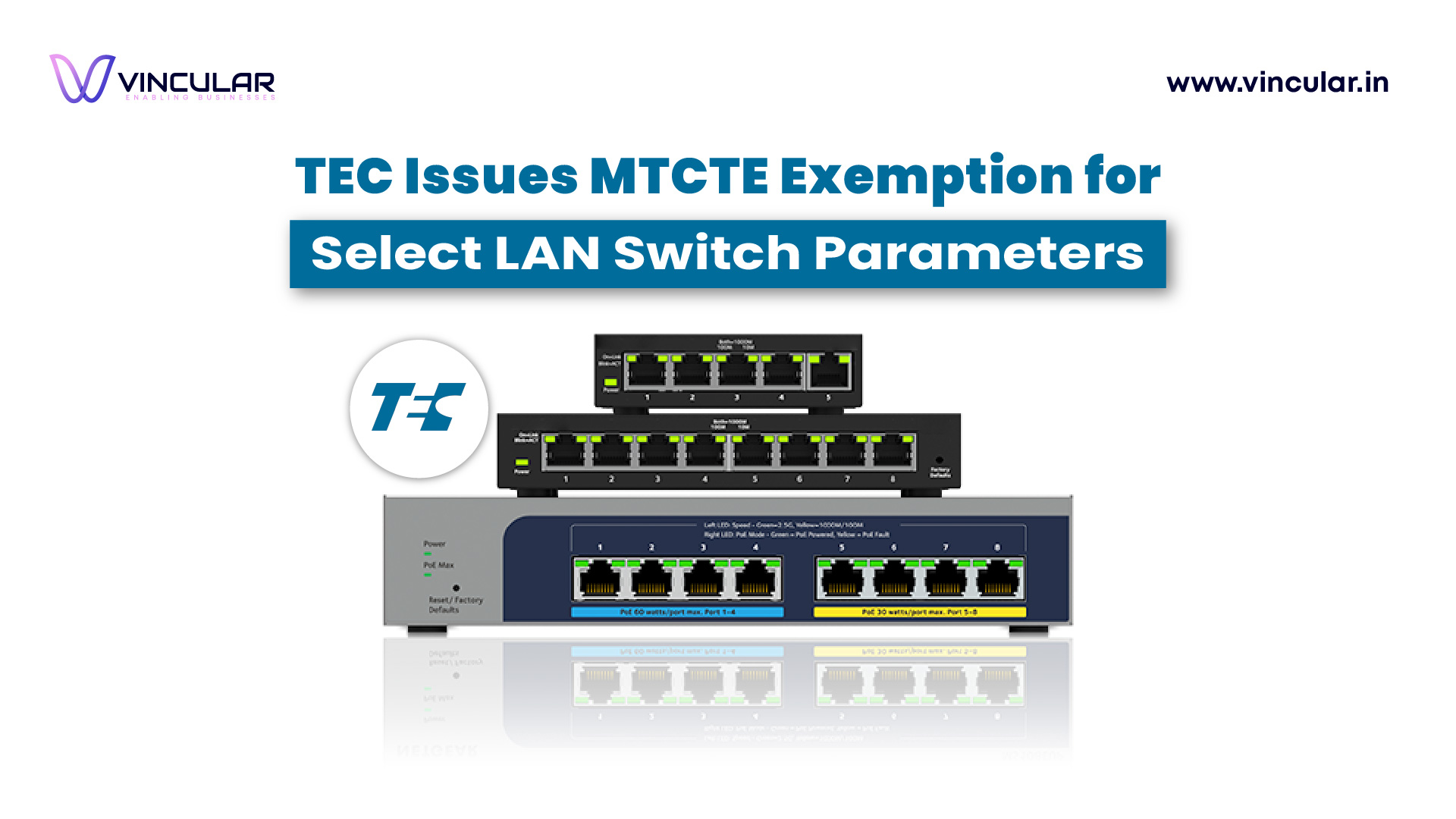
The Telecom Engineering Centre (TEC) has issued a new notification granting exemptions from the submission of test reports for specific test parameters related to LAN Switch ERs.
- Validity: These exemptions are applicable until April 30, 2026.
| S.No. | Product/ER Variant | Parameter Name (as
per ER) |
Standard
Name (as per ER) |
| 01 | Fabric Interconnect switch | Fibre Channel Frame
Encapsulation |
RFC 3643
Annex-P11 |
| Fibre Channel Static
Routing |
RFC 2625
Annex-P11 |
||
| 02 | SAN switch | Fibre Channel Management | RFC 4044
Annex-P11 |
| Fibre Channel Static
Routing |
RFC 2625
Annex-P11 |
OEM Requirement: Manufacturers (OEMs) are required to submit an undertaking on the MTCTE portal confirming that the equipment does not support the specified parameters for each relevant entry.
This exemption aims to streamline compliance under MTCTE and facilitate smoother certification processes for the LAN switch products.
You can access the official circular issued by the ministry from here: Test Report Exemptions for Select LAN Switch Parameters
BIS-ISI
BIS Quality Control Order for Hand Tools
The Department for Promotion of Industry and Internal Trade (DPIIT) has introduced the Hand Tools (Quality Control) Order, 2025. It shall come into force on 1st October 2026.
Earlier, the implementation date for hand tools was 1st October 2025. However, through the newly issued Quality Control Order, the Ministry has extended the implementation timeline by one year to 1st October 2026.
This order requires that all goods/articles mentioned in the order must comply with their respective Indian Standard before the new notified implementation date to sell, import or distribute into the Indian Market.
The products must display the Standard Mark under a license from the Bureau of Indian Standards, in accordance with Scheme-I of Schedule-II of the Bureau of Indian Standards (Conformity Assessment) Regulations, 2018.
The following goods/articles are covered under this order:
| Sr. No. | Goods/Articles | Indian Standard | Implementation Date |
| 1. | Pipe Wrenches General Purpose | 4003 (Part 1):1978 | 1st October 2026 |
| 2. | Pipe Wrenches Heavy Duty | 4003(Part 2):1986 | |
| 3. | Open-Jaw Wrenched (Spanners) | 2028:2004 | |
| 4. | Ring Wrenches (Spanners) | 2029:1998 | |
| 5. | Single-ended Open jaw Adjustable Wrenches | 6149:1984 | |
| 6. | Chain Pipe Wrenches | 4123:1982 | |
| 7. | Open-Ended Slugging Wrenches (Spanners) | 4508:1992 | |
| 8. | Ring Slugging Wrenches (Spanners) | 4509:1992 | |
| 9. | Combination Side Cutting Pliers | 3650:1981 |
Date of Implementation:
- For General (Large Enterprises): 1st October 2026.
- For Small Enterprises: 1st January 2027.
- For Micro Enterprises: 1st April 2027.
Exemptions under this order:
- Export Goods: Products manufactured in India exclusively for export are exempt from the scope of this Order.
- R&D Exemption: Manufacturers of Hand Tools, which are covered under this order, are allowed to import up to 200 numbers per year for research and development purposes, provided they are not sold, are scrapped after use, and year-wise records are submitted to the Central Government with a signed declaration.
You can access the official circular issued by the ministry from here: Hand Tools QCO 2025.pdf
Voice Compliance
Mandatory Adoption of 1600-Series Numbers for IRDAI-Regulated Entities
The Telecom Regulatory Authority of India (TRAI) has issued a Direction dated 16 December 2025, mandating the use of 1600-series numbering for all service and transactional voice calls made by entities regulated under the Insurance Regulatory and Development Authority of India (IRDAI).
This directive introduces a defined and time-bound migration framework, reinforcing ongoing efforts to curb unsolicited commercial communications and enhance consumer trust in legitimate service calls.
Background
In coordination with the Department of Telecommunications (DoT) and sectoral regulators, TRAI has been actively working to prevent the misuse of ten-digit mobile numbers and to address the growing concern around spam and fraudulent calls.
As part of this initiative, the 1600-series numbering range was exclusively allocated to BFSI entities, enabling customers to clearly distinguish genuine service and transactional calls from promotional or unsolicited communications.
Although the adoption of the 1600-series has been encouraged across the BFSI sector, TRAI has now issued a direction prescribing a mandatory migration timeline for IRDAI-regulated entities.
Key Directions Issued by TRAI
- Mandatory migration to the 1600-series for service and transactional voice calls by 15 February 2026.
- Post 15 February 2026, calls from any other numbering series will not be permitted, even if customer consent (explicit or inferred) is available.
- Complaints of unsolicited commercial communication against non-compliant entities may invite action under provisions applicable to unregistered telemarketers.
- Access Providers are required to periodically report compliance status to TRAI.
Why This Matters
This regulatory direction strengthens consumer protection, improves trust and transparency in service communications, and supports industry-wide measures to reduce spam, fraud, and misuse of telecom resources.
With clearly defined timelines now in place, early adoption and readiness planning will be critical for IRDAI-regulated entities to ensure seamless customer engagement and avoid regulatory exposure.
You can access the official circular issued by the ministry from here: Adoption of 1600-Series Numbers for IRDAI Circular
BEE
Induction Hobs – Transition to Mandatory BEE Labelling Scheme from the next year
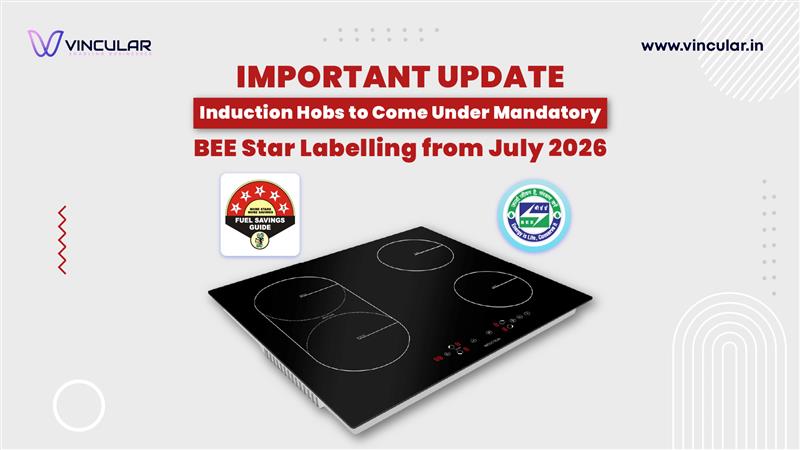
This is to inform you that Induction hob will be transition from the voluntary to mandatory regime of BEE from the next year in the July month. The mandatory BEE star labelling requirement will be effective from 1 July 2026.
For general knowledge, products covered under the BEE scope include:
- All types of countertop induction hobs.
- Products commonly called induction cooktops or stoves.
- Products meant for household or similar use, with cooking zones.
This step will ensure greater transparency and energy efficiency in household appliances.
You can access the official circular issued by the ministry from here: Induction Hobs – Transition to Mandatory
WASTE MANAGEMENT
Important Update on EPR Certificate Shortage for Plastic Packaging (Category II & III)
On 28 November 2025, the Central Pollution Control Board (CPCB) has issued an important notification addressing the shortage of EPR certificates in Category II & III recycling certificates, which has made it difficult for PIBOs to meet their EPR obligations on the portal.
Key Highlights of the Notice:
▪️ As per PWM Rules, PIBOs must meet minimum recycling targets from FY 2024-25 onward.
▪️ Rule 15A allows CPCB to permit the use of surplus EPR certificates from one category to meet deficits in another.
New Flexibilities allowed by CPCB
- Use End-of-Life (EOL) certificates (Cat II / III) to fulfil recycling obligations.
- For every 1 ton of recycling obligation, PIBOs have to use 1.5 tons of EOL certificates.
- Use EOL certificates while filing your Annual Return (AR), or to cover shortfalls in ARs via the official credit-exchange system.
Applicability: These provisions are valid only till the Annual Return filing for FY 2024-25.
PIBOs with shortfalls in Annual Recycling (AR) may offset the gap using EOL certificates via the Credit Exchange module.
This move aims to support smoother compliance and ensure effective implementation.
MoEF&CC Extends Annual Return Filing Deadline for FY 2024-25 under PWM Rules 
The Ministry of Environment, Forest and Climate Change (MoEF&CC) has officially extended the deadline for filing Annual Returns for FY 24-25 under the Plastic Waste Management (Second Amendment) Rules, 2023.
New Deadline: 31 January 2026.
Applicable to: Registered Producers, Importers, Brand Owners (PIBOs) and Plastic Waste Processors (PWPs).
All registered PIBOs and PWPs are encouraged to utilise this extended timeline to complete their filings to avoid non-compliance and penalties.
Stay Updated, Stay Compliant – Subscribe to our Newsletter Now!
Whether it’s important compliance notifications or changes in policies and regulations, we’ve got it covered.
Subscribe to our Free Monthly Newsletter or watch our Latest News & Updates Space for daily updates to stay ahead with the latest regulations and notifications without spending a dime!