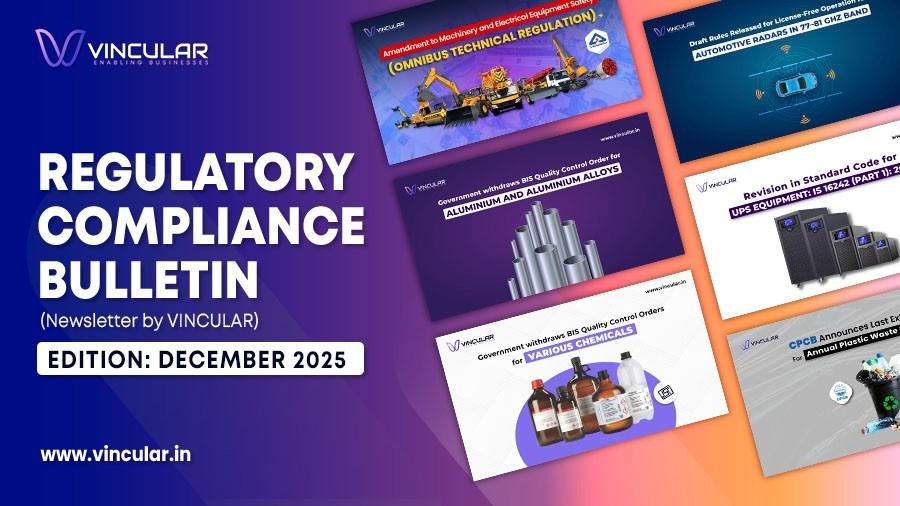
REGULATORY COMPLIANCE BULLETIN NEWSLETTER – DECEMBER 2025
Case Study Vincular Helped a Global CCTV Brand Achieve ER Compliance The Customer A leading global manufacturer of IP-based CCTV and security surveillance products looking to expand smoothly into the Indian market with full regulatory compliance. What Was Required With the introduction of the Essential Requirements (ER) Standards for CCTV
Case Study
Vincular Helped a Global CCTV Brand Achieve ER Compliance
The Customer
A leading global manufacturer of IP-based CCTV and security surveillance products looking to expand smoothly into the Indian market with full regulatory compliance.
What Was Required
With the introduction of the Essential Requirements (ER) Standards for CCTV products in India, achieving compliance required a rigorous focus on cybersecurity, process documentation, and technical alignment to national regulations.
The customer needed a strong partner capable of managing:
- Ensuring compliance with new STQC cybersecurity requirements under ER Standards.
- Extensive documentation and audit requirements across hardware, software, and the supply chain.
- Continuous monitoring during lab testing to address technical gaps in real time.
- Cross-functional coordination between regulatory authorities in India, the STQC lab, and an international R&D team across time zones.
Meeting these expectations demanded precision, speed, and expert regulatory navigation.
How Vincular Helped
Vincular took full responsibility for the compliance journey, combining technical depth, process discipline, and strong collaboration with stakeholders.
- Project initiation in May 2025, with the application submitted to STQC and a clear target to complete within 90 working days.
- Daily technical calls with STQC leadership and the customer’s R&D team to streamline decisions and maintain progress.
- Guided the customer through:
- Hardware testing
- Software validation
- Supply chain and documentation review
- Factory audit
- Built a highly collaborative relationship with the STQC operational team, enabling smooth execution through challenges.
Thanks to this structured and proactive approach, the project continued without disruption and stayed aligned to the planned completion milestone.
If Vincular Wasn’t Involved
- Significant delays in approval timelines.
- Increased costs due to extended technical discussions and test cycles.
- Postponed market entry, affecting revenue and competitiveness.
- Risk of the project being put on hold or restarted, resulting in loss of time and effort.
But the Result was:
- The product successfully cleared ER Standard testing.
- The test report was approved and uploaded to the BIS portal.
- Full CCTV regulatory compliance certification was achieved within the planned window.
- The collaboration strengthened Vincular’s domain expertise and established a foundation for handling larger, more complex CCTV compliance programs in the future.
Real Words, Real Trust
The customer appreciated Vincular for:
- Excellent technical capability
- Structured process and disciplined execution
- Rapid problem-solving and faster response time
- Transparent communication and continuous support
Conclusion
This project marks a significant milestone for Vincular’s Security Business Unit, proving that even complex and evolving compliance environments can be successfully navigated with strong technical leadership, well-defined processes, and collaborative engagement with regulatory authorities.
BIS-CRS
Revision in Standard Code for UPS Equipment: IS 16242 (Part 1): 2025
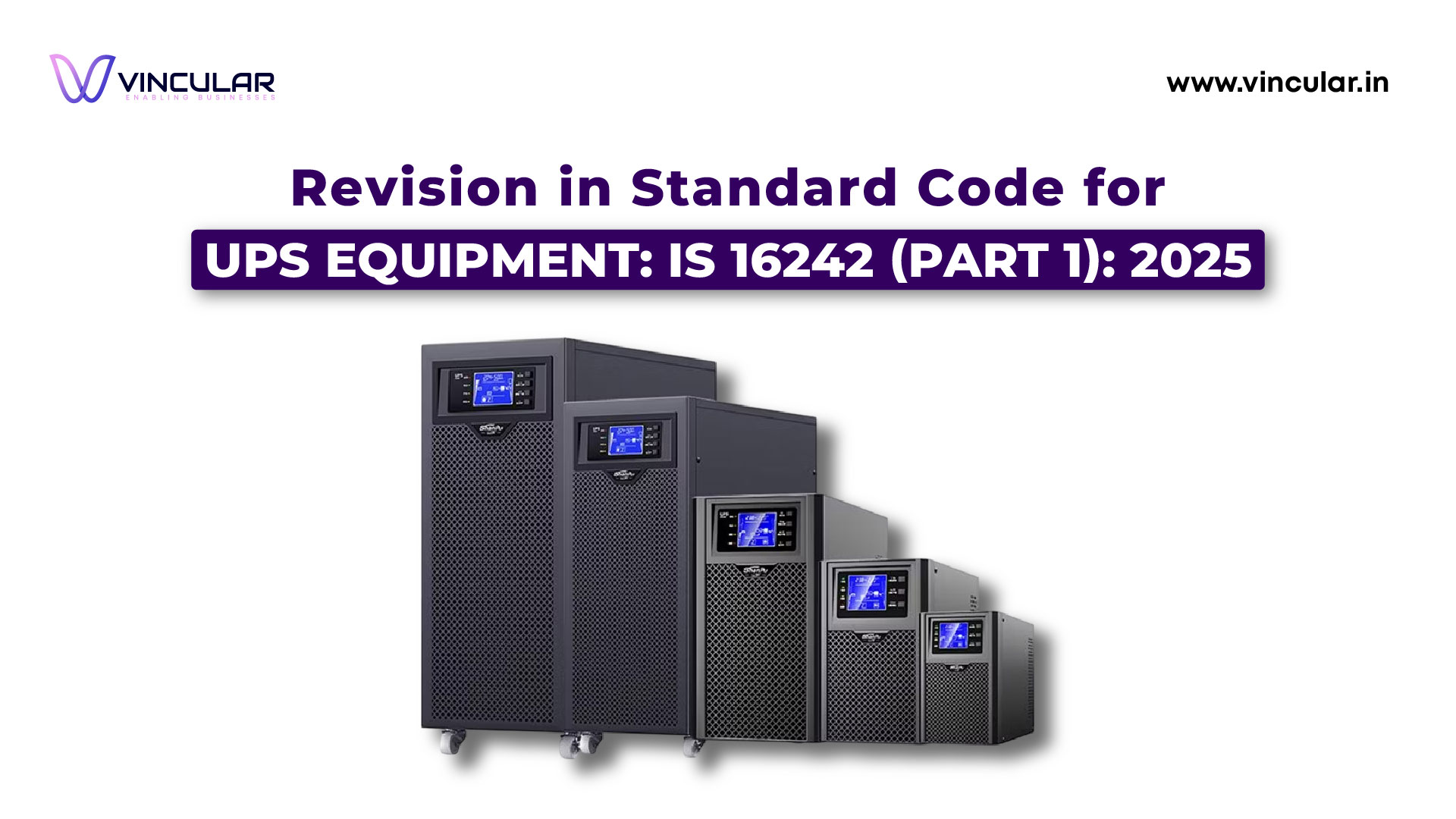
BIS (Bureau of Indian Standards) released a new notification on 10 October 2025, regarding the implementation of the revised standard IS 16242 (Part 1): 2025 for UPS equipment.
BIS has also made a small change in the way the standard reference is written.
Earlier: IS 16242 (Part 1): 2025 / IEC 62040-1: 2017
Now revised as: IS 16242 (Part 1): 2025 / IEC 62040-1: 2017 + AMD1: 2021 + AMD2: 2022 CSV
This update includes the latest international amendments (AMD1:2021 and AMD2:2022) in the IEC standard.
The technical requirements remain mostly the same, but the reference now aligns with the most recent global version of the standard.
For more information you can refer to the official notification from here: Rivised Standard Code for UPS Equipment
Migration of IS 13252: Part 1 and IS 616:2017 to IS/IEC 62368 : Part 1 : 2023
After much speculations and discussion, The Ministry of Electronics and Information Technology (MeitY) has officially announced the migration of IS 13252 : Part 1 : 2010 and IS 616:2017 to IS/IEC 62368: Part 1: 2023 through a Gazette notification published on 7th November, 2025.
The notification also introduces a new product category and specifies the concurrent running period of IS 13252 & IS 616 along with IS/IEC 62368: Part 1: 2023.
Key Highlights:
- IS 13252: Part 1: 2010 and IS 616:2017 have been superseded by IS/IEC 62368: Part 1: 2023 “Audio/Video, Information and Communication Technology Equipment – Part 1 Safety Requirements”.
- New Product Category — Extended Reality Products (Augmented Reality, Virtual Reality, Mixed Reality etc.) has been included to the “Electronics and Information Technology Goods (Requirements for Compulsory Registration) Order, 2021 as 65th Sr. No.
- Concurrent Running of IS 13252 & IS 616 with IS/IEC 62368:1,
- For Extended reality products (New Licenses): 1st May 2026.
-
- For all other products under IS 13252 and IS 616 (Existing or new Licenses): 1st November 2028.
- After 1st November 2028, IS 13252 and IS 616 will be completely withdrawn, and only IS/IEC 62368:1 will remain applicable.
Benefits of Migration to IS/IEC 62368:1
The intention of the Ministry has always been to benefit the Industry, its Stakeholder, all the Consumers & the Economy. Points below are of benefit reference,
- Unified Standard: Various modern equipment overlaps with the scope of IS 13252 and IS 616. Combining of Audio/Video and IT standards will help in simplifying compliance.
- Uniformity with Global Standards: Aligns Indian Standards with IEC 62368, facilitating easier international trade.
- Supports Emerging Technologies: Maintains the relevancy of safety standards to new age technologies like AR, VR and MR.
The notification has been released after much deliberation within the Govt. & its Stakeholders. The Ministry has also considered all the points from the concerned authorities and accordingly, the implementation timeline has also been kept for a span of 3 years for the existing Licenses. The same had also been requested by the industry in earlier meetings with the MeitY.
Further, the Guidelines to Migrate into the new standard IS/IEC 62368: Part 1: 2023 are yet to be released for existing and New Licensees.
For more information you can refer to the official gazette notification from here: Migration of IS 13252
BIS-ISI
Government withdraws BIS Quality Control Order for Aluminium and Aluminium Alloys
The Ministry of Mines, Government of India, has officially withdrawn the Quality Control Order (QCO) for Aluminium and Aluminium Alloys.
The following products are withdrawn from mandatory BIS certification covered under the Aluminium and Aluminium Alloys (Quality Control) Order, 2023.
| Sr. No. | Goods or article | Indian Standard |
| 1 | Aluminium and aluminium alloy ingots and castings | IS 617 |
| 2 | High purity primary aluminium ingot | IS 11890 |
| 3 | Aluminium alloy ingots for bearings | IS 6754 |
| 4 | Primary aluminium ingots for remelting | IS 2590 |
| 5 | Aluminium ingots billets and wire bars (EC GRADE) | IS 4026 |
As per the Gazette Notification dated 13th November 2025, these products are no longer under mandatory BIS-ISI certification, effective immediately.
This move has been taken in the public interest after consultation with the Bureau of Indian Standards (BIS).
For more information you can refer to the official gazette notification from here: Withdrawn of QCO for Aluminium and Aluminium Alloys
Government withdraws BIS Quality Control Order for Copper
The Ministry of Mines, Government of India, has officially withdrawn the Quality Control Order (QCO) for copper.
As per the Gazette Notification dated 13th November 2025, the copper as per IS 191 is no longer under mandatory BIS-ISI certification, effective immediately.
This move has been taken in the public interest after consultation with the Bureau of Indian Standards (BIS).
For more information you can refer to the official gazette notification from here: Withdrawn of QCO for Copper
Government revokes BIS Quality Control Orders for various Chemicals, Fertilizers, Polymers & Textiles
The Ministry of Chemicals and Fertilizers, Government of India, has officially withdrawn the Quality Control Order (QCO) for various Chemicals, Fertilizers, Polymers & Textiles.
The following QCOs along with specific Indian standards have been withdrawn:
- Terephthalic Acid (Quality Control) Order, 2021 – IS 15030:2001
- Ethylene Glycol (Quality Control) Order, 2021 – IS 5295:1985
- 100 Percent. Polyester Spun Grey and White Yarn (Quality Control) Order, 2023 – IS 17265:2019
- Polyester Industrial Yarn (IDY) (Quality Control) Order, 2022 – IS 17264:2019
- Polyester Staple Fibres (PSF) (Quality Control) Order, 2022 – IS 17263:2019
- Polyester Continuous Filament Fully Drawn Yarn (Quality Control) Order, 2023 – IS 17261:2019
- Polyester Partially Oriented Yarn (Quality Control) Order, 2023 – IS 17262:2019
- Polyethylene Material for moulding and extrusion (Quality Control) Order, 2022 – IS 7328:2020
- Acrylonitrile Butadiene Styrene (ABS) (Quality Control) Order, 2021 – IS 17077 :2019
- Polypropylene (PP) Materials for Moulding and Extrusion (Quality Control) Order, 2024 – IS 10951: 2020
- Poly Vinyl Chloride (PVC) Homopolymers (Quality Control) Order, 2024 – IS 17658:2021
- Ethylene Vinyl Acetate (EVA) Copolymers (Quality Control) Order, 2022 – IS 13601:1993
- Polyurethanes (Quality Control) Order, 2021 – IS 17397 (Part 1) : 2020
- Polycarbonate (Quality Control) Order, 2021 – IS 14434:1998
As per the Gazette Notification dated 12th November 2025, these products are no longer under mandatory BIS-ISI certification, effective immediately.
This move has been taken in the public interest after consultation with the Bureau of Indian Standards (BIS).
For more information you can refer to the official gazette notification from here: Withdraw of QCO for various Chemicals, Fertilizers, Polymers & Textiles
Government withdraws BIS Quality Control Orders for Various Chemicals
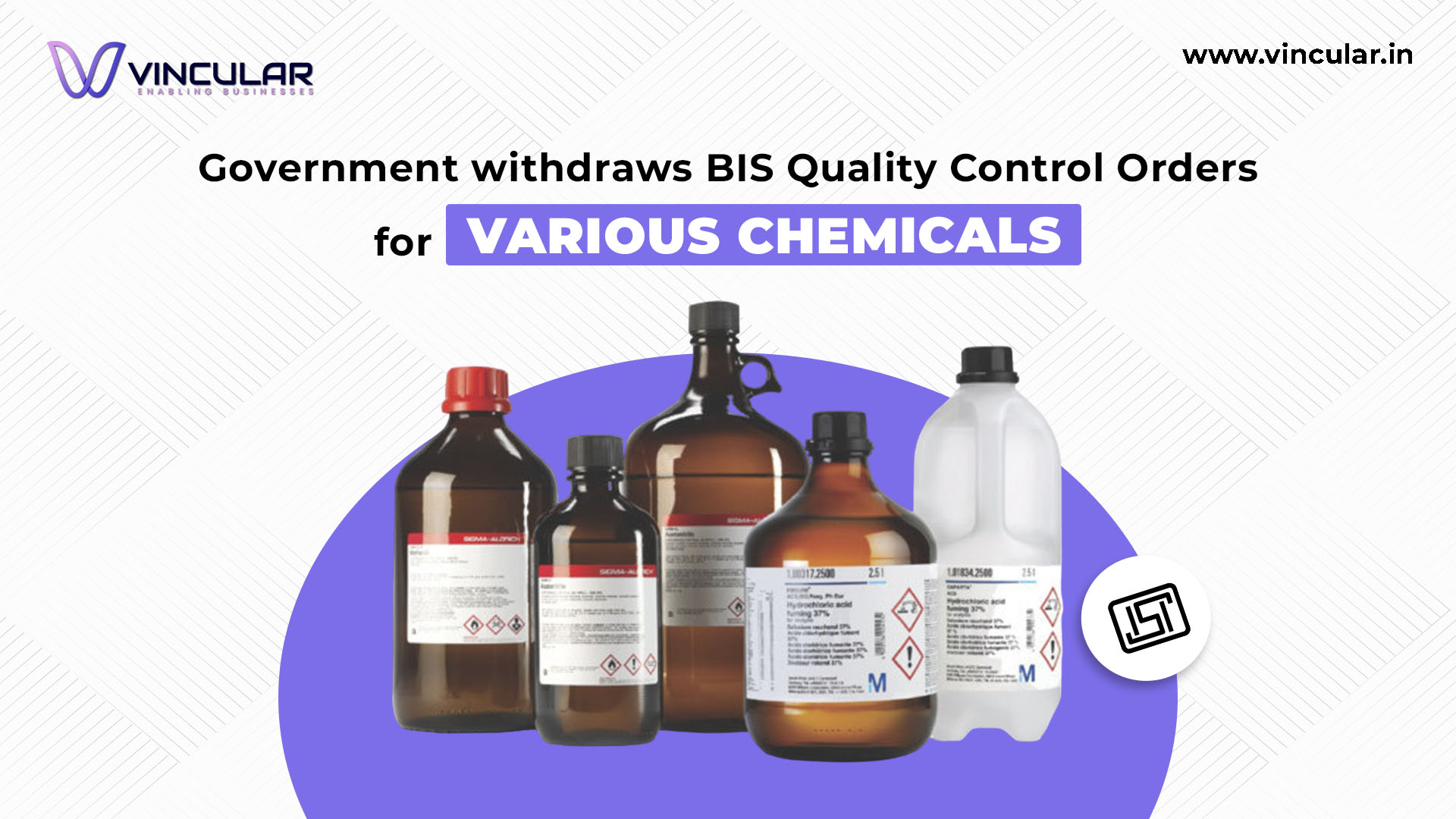
The Ministry of Chemicals and Fertilizers, Government of India, has officially withdrawn the Quality Control Order (QCO) for various Chemicals.
The following QCOs along with specific Indian standards have been withdrawn:
- Pyridine (Quality Control) Order, 2020.- IS 8058:2018
- Beta Picoline (Quality Control) Order, 2020 – IS 16112:2013
- Sodium Tripolyphosphate, (Quality Control) Order, 2020 – IS 6100:1984
- H Acid (Quality Control) Order, 2024 – IS 8637: 2020
- K Acid (Quality Control) Order, 2024 – IS 11557: 1986
- Vinyl Sulphone (Quality Control) Order, 2024 – IS 18340: 2023
As per the Gazette Notification dated 20th November 2025, these chemicals are no longer under mandatory BIS-ISI certification, effective immediately.
This move has been taken in the public interest after consultation with the Bureau of Indian Standards (BIS).
For more information you can refer to the official gazette notification from here: Withdraw of QCO for various Chemicals
Government withdraws BIS Quality Control Order for Viscose Staple Fibres
The Ministry of Textiles, Government of India, has officially withdrawn the Quality Control Order (QCO) for Viscose Staple Fibres.
As per the Gazette Notification dated 18th November 2025, the Viscose Staple Fibres as per IS 17266 is no longer under mandatory BIS-ISI certification, effective immediately.
This move has been taken in the public interest after consultation with the Bureau of Indian Standards (BIS).
For more information you can refer to the official gazette notification from here: Withdraw of Viscose Staple Fibres QCO
Government withdraws BIS Quality Control Order for Four Non-ferrous Refined Metals
The Ministry of Mines, Government of India, has officially withdrawn the Quality Control Order (QCO) for four non-ferrous refined metals.
The following QCOs along with specific Indian standards have been withdrawn:
- Refined Nickel (Quality Control) Order, 2025 – IS 2782: 2023
- Primary Lead (Quality Control) Order, 2025 – IS 27: 2023
- Refined Zinc (Quality Control) Order, 2025 – IS 209: 2024
- Tin Ingot (Quality Control) Order, 2025 – IS 26: 2024
As per the Gazette Notification dated 13th November 2025, these products are no longer under mandatory BIS-ISI certification, effective immediately.
This move has been taken in the public interest after consultation with the Bureau of Indian Standards (BIS).
For more information you can refer to the official gazette notification from here:
Scheme-X
Amendment to Machinery and Electrical Equipment Safety (Omnibus Technical Regulation)
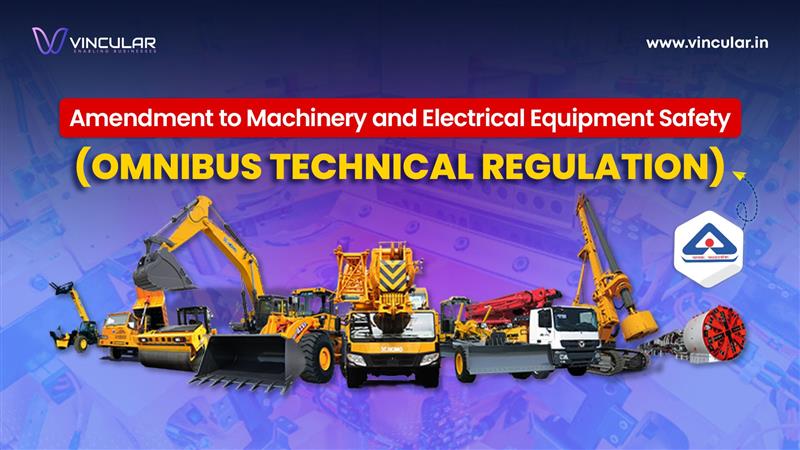
The Ministry of Heavy Industries has issued the Machinery and Electrical Equipment Safety (Omnibus Technical Regulation) Second Amendment Order, 2025, published on 13 November 2025.
The MHI has deferred the previously announced compliance commencement date for the Machinery & Electrical Equipment Safety (Omnibus Technical Regulation) Order, 2024. Earlier timelines—including the amended date of 1 September 2026—are now put on hold. The regulation will instead come into effect on a new date that will be notified separately through the Official Gazette.
This deferral temporarily pauses mandatory compliance requirements, giving industry additional time to prepare for testing, documentation, and BIS-aligned certification. Stakeholders should monitor upcoming notifications for the revised timeline.
For more information you can refer to the official gazette notification from here: Amendment to Machinery and Electrical Equipment Safety (Omnibus Technical Regulation)
Amendment to the Electrical Equipment (Quality Control) Order
The Ministry of Heavy Industries has issued a notification deferring the implementation timelines for the upcoming phase of the Electrical Equipment (Quality Control) Order and its subsequent amendments.
All product categories covered under the QCO—except those already enforced on 10 November 2024 under Sr. No. 1.1(a) (Low-Voltage Switchgear and Controlgear: Circuit Breakers)—will now have their enforcement dates postponed until further notice.
What This Means
- Mandatory BIS compliance for the remaining product categories is temporarily paused.
- The Ministry will announce a revised enforcement date through a future Gazette notification.
- This extension provides manufacturers, importers, and supply-chain partners with additional time to prepare for documentation, testing, and BIS-related conformity requirements.
For more information you can refer to the official gazette notification from here: Amendment to the Electrical Equipment (Quality Control) Order
WPC
Draft rules Released for Short-Range Automotive Radar System in the 77 to 81 GHz Band

The Ministry of Communications has released draft rules titled “Use of Short-Range Automotive Radar System in the 77 to 81 GHz Band (Exemption from Assignment Requirement) Rules, 2025.
Key highlights:
- Automotive radars operating in the 77–81 GHz band will be exempted from individual frequency assignments. Currently, only the 76–77 GHz band is exempted from licensing requirements.
- All equipment must be type-approved and meet with the parameters mentioned in the GSR.
Public Consultation Window: Stakeholders can submit their comments on the draft notification by 25 Dec 2025 to the Joint Secretary (Telecom), Department of Telecommunications.
For more information you can refer to the official gazette notification from here: Draft rules Released for Short-Range Automotive Radar System in the 77 to 81 GHz Band
VOICE COMPLIANCE
TRAI 1600-Series Direction: Compliance Update for BFSI Sector
TRAI has issued a new Direction (19 Nov 2025) to enhance customer communication security and regulate unsolicited commercial communications (UCC). This mandates all RBI, SEBI, and PFRDA regulated entities to migrate service and transactional voice calls to the 1600-series within specified timelines.
Key Points:
- All regulated entities must transition to the 1600-series for service and transactional calls.
- After deadlines, no other number series may be used, even with customer consent.
- Non-compliance may lead to regulatory action under UCC rules.
- Access Providers must submit periodic compliance reports to TRAI.
Phase-wise Deadlines:
RBI:
- Commercial Banks – 1 Jan 2026
- Large NBFCs (Asset size above 5000 crore), Payments Banks, Small Finance Banks – 1 Feb 2026
- Remaining NBFCs, Co-operative Banks, Regional Rural Banks – 1 Mar 2026
SEBI:
- Mutual Funds & Asset Management Companies – 15 Feb 2026
- Qualified Stockbrokers – 15 Mar 2026
- Other intermediaries – voluntary
PFRDA:
- CRAs & Pension Fund Managers – 15 Feb 2026
Timely migration to the 1600-series is essential to remain compliant, safeguard customer trust, and ensure secure, authentic communications.
TRAI Issues New Guidelines for SMS Templates under TCCCPR 2018
On 18 November 2025, TRAI released a Direction aimed at improving the security and reliability of SMS communications. The update focuses on the proper use of SMS content templates, particularly controlling URLs, callback numbers, and variable fields used in messages.
Key Highlights:
- All variables in an SMS template must now be pre-tagged with specific labels, such as #number#, #url#, #cbn#, #email#, or #alphanumeric#.
- Access Providers will validate these tagged variables against whitelisted URLs, APK/OTT links, and callback numbers within 30 days.
- New SMS templates submitted 10 days after the Direction will only be approved if they follow the new tagged-variable format.
- Existing templates must be updated to the new format within 60 days from the start of validation.
- During the first 60 days, messages will continue to be delivered even if validation fails (Logger Mode). After this period, non-compliant messages will be automatically rejected.
- Principal Entities will be notified of any validation issues along with recommended corrective actions.
These changes are intended to prevent misuse of SMS templates, strengthen compliance, and improve the trustworthiness of commercial communications.
WASTE MANAGEMENT
CPCB Announces Last Extension for Annual Return Filing for Plastic Waste Processors
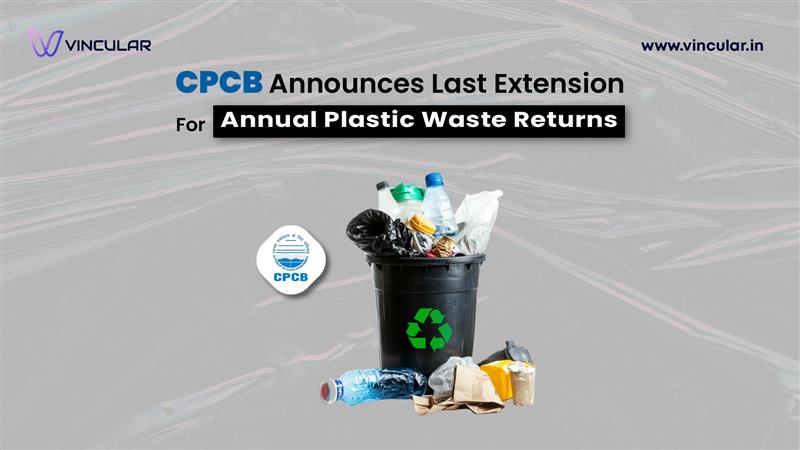
The Central Pollution Control Board (CPCB) has issued an important notification extending the Annual Return (AR) filing deadlines for all registered PIBOs (Producers, Importers & Brand Owners) and PWPs (Plastic Waste Processors).
Despite earlier extensions, several entities had not completed their filings—prompting CPCB to grant a final extension.
New Deadline: 30 November 2025
This applies to both PIBOs & PWPs.
Entities failing to comply by this date may face Environmental Compensation (EC) as per PWM Rules.
Important Note: Annual Return filing is a critical component of India’s EPR framework. It ensures transparency, traceability and accountability in plastic waste management. With CPCB publishing the list of non-compliant entities, timely action is more important than ever.
This is a crucial reminder for all obligated entities—EPR compliance is no longer optional, it’s a regulatory necessity.
Stay Updated, Stay Compliant – Subscribe to our Newsletter Now!
Whether it’s important compliance notifications or changes in policies and regulations, we’ve got it covered.
Subscribe to our Free Monthly Newsletter or watch our Latest News & Updates Space for daily updates to stay ahead with the latest regulations and notifications without spending a dime!